
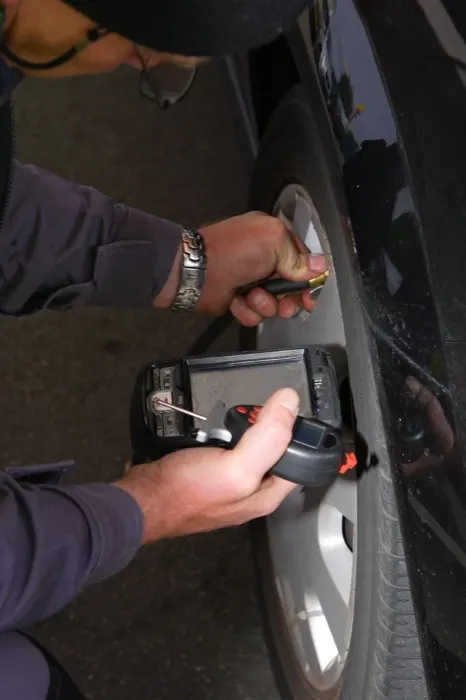
How to Check and Set Your Tyre Pressure (And Why It Matters)
To set your tyre pressure correctly, find your car's recommended figures (in the handbook, on the fuel filler flap or the driver's door sill), check the tyres when cold, and inflate each to the right PSI using a reliable gauge. Recheck monthly and before long trips.
Where to find the right pressure for your car
The correct pressures are set by your car maker, not the tyre, so never guess. You will usually find them printed on a label inside the driver's door sill or on the fuel filler flap, and always in the owner's handbook.
Many cars list two figures: a normal load and a fully laden figure for when the car is packed with passengers and luggage. Use the laden figure before a holiday or heavy trip. Some labels also show different pressures for different tyre sizes, so match the row to the size on your tyres.
How to check and set the pressure
Check pressures when the tyres are cold, meaning the car has been parked for a couple of hours or driven less than a couple of miles. Warm tyres read higher and will give you a false result.
- Unscrew the valve cap and press a gauge firmly onto the valve.
- Compare the reading with your car's recommended PSI.
- Add air a little at a time, rechecking as you go, and let air out if over.
- Refit the valve caps and do not forget the spare.
Petrol station air lines vs home gauges
Forecourt air machines are convenient but not always accurate, as they take a beating and are rarely calibrated. If you use one, set your figure, inflate, then recheck with your own gauge if you have one.
A decent digital or dial gauge from a motor factor costs only a few pounds and lets you check at home whenever you like. Whatever you use, the key is consistency: check the same way each time and act on any tyre that keeps dropping, as that points to a slow puncture.
Why correct pressure matters
Pressure affects safety, running costs and tyre life. Under-inflated tyres flex more, build up heat and can fail at speed, as well as lengthening your braking distance.
They also increase rolling resistance, which wastes fuel, and they wear faster on the edges. Over-inflated tyres wear in the centre and give a harsher ride with less grip. Correct pressure keeps the whole tread in contact with the road, which is best for grip, wear and economy alike.
What about the TPMS warning light?
Most cars registered from 2014 have a tyre pressure monitoring system (TPMS) that warns you when a tyre is low. If the light comes on, check all your pressures as soon as it is safe to do so.
A TPMS warning can also mean a slow puncture. If a tyre keeps losing pressure, bring it in: many punctures can be safely repaired rather than replaced. An illuminated TPMS light is also an MOT failure, so it should not be ignored or taped over.
How temperature changes your pressure
Air expands when warm and contracts when cold, so your tyre pressure naturally rises and falls with the weather. A cold snap can drop pressures by a couple of PSI overnight, which is why the warning light often appears on the first frosty morning of autumn.
This is normal and the fix is simply to top up to the correct cold figure. Do not over-inflate to compensate for the cold, and remember the reading will rise again once the tyres warm up with driving. Because of this, winter is a good time to check pressures more often than usual.
Frequently Asked Questions
How often should I check my tyre pressure?
Check at least once a month and before any long journey. Tyres lose a little pressure naturally over time, and a monthly check catches slow punctures early. It only takes a couple of minutes and protects your safety, fuel economy and tyre life.
Should I check pressures hot or cold?
Always check when cold, ideally before driving or after less than a couple of miles. Driving heats the air inside the tyre and raises the reading, so a hot check makes pressures look higher than they really are and leads to under-inflation.
Is it bad to slightly over-inflate tyres?
A few PSI over is less risky than being under, but too high reduces grip, gives a harsh ride and wears the centre of the tread. Stick to your car maker's recommended figure, using the laden setting when carrying a heavy load.
Where do I find the right tyre pressure?
Check the label inside the driver's door sill or on the fuel filler flap, or look in the owner's handbook. Never use the maximum pressure printed on the tyre sidewall, as that is the tyre's limit, not your car maker's recommended setting.
Why does one tyre keep losing pressure?
A single tyre that repeatedly drops usually has a slow puncture, often from a nail or screw, a faulty valve, or a poor seal between tyre and rim. Have it checked promptly, as many slow punctures can be safely repaired rather than needing a new tyre.
Book With Norwich Tyres & Auto Service
Need a hand from a real, independent Norwich garage? Call 07933 900901 or pop into Ber Street, NR1 3ES. Same-day tyre fitting is available on most common sizes, with free parking on site.
Hero image: “Tyre Safety Check” by First Stop - Bridgestone's UK tyre retail network (source), licensed under CC BY.