
UK Tyre Law Explained: Tread Depth, Fines and Penalty Points
UK law requires every car tyre to have a minimum of 1.6mm of tread across the central three-quarters of its width and around its whole circumference. Tyres must also be free from dangerous cuts, lumps and bulges, correctly inflated, and the right size and load rating for the vehicle.
The legal minimum tread depth
For cars, vans and light trailers, the legal minimum tread depth is 1.6mm. It is measured across the central three-quarters of the tyre and around the entire circumference, so a tyre that is legal in one spot can still be illegal elsewhere.
Tread clears water from under the tyre. As it wears down, wet-weather grip and braking get worse, which is why the law sets a firm limit. The simple 20p test is a handy way to keep an eye on it between professional checks.
Fines and penalty points
Driving on an illegal tyre can lead to a fine of up to £2,500 and 3 penalty points, and that penalty applies per tyre. Two illegal tyres could mean 6 points, and four could mean 12, which is enough to lose your licence.
Beyond the legal risk, worn tyres are a genuine safety hazard for you and everyone around you. The cost of replacement is small compared with the fine, the points, or the consequences of a crash, so there is never a good reason to gamble on a borderline tyre.
What else makes a tyre illegal?
Tread depth is only part of the law. A tyre is also illegal if it has certain types of damage or is unsuitable for the vehicle.
- Cuts longer than 25mm or 10% of the section width that reach the cords.
- Lumps, bulges or tears caused by separation or structural failure.
- Exposed ply or cord anywhere on the tyre.
- Mixing certain tyre types across an axle, or fitting the wrong size or speed rating.
Pressure and mixing tyres
The law also expects your tyres to be correctly inflated and suitable for use together. A tyre that is significantly under or over-inflated for the load is not maintained in a fit condition, and incorrect pressures cause uneven wear that can quickly take a tyre below the legal limit on one edge.
You must not fit cross-ply and radial tyres on the same axle, and tyres on the same axle should match in size and construction. If you are unsure whether a mismatched set is legal, ask us before driving on it.
How the MOT checks your tyres
Your tyres are inspected at every MOT. The tester checks tread depth, condition, correct fitment and that the tyre is not damaged or perished. A tyre below 1.6mm or with dangerous damage is an automatic failure.
An MOT pass is a snapshot on the day, though. Tyres keep wearing, so it is sensible to check them yourself through the year. If you are unsure, we offer free visual tyre checks at our Norwich garage.
Who is responsible, you or the previous owner?
As the driver and registered keeper, you are responsible for the condition of your tyres at all times, regardless of who fitted them or when. Buying a used car does not transfer any blame for illegal tyres to the seller once you drive away.
This is why a tyre check is one of the first things worth doing on a newly bought used car. We frequently find borderline or wrongly specified tyres on recently purchased vehicles, and it is far better to discover that on our ramp than at the roadside or after a fine.
Frequently Asked Questions
Does the 1.6mm limit apply to all tyres?
For most cars, vans and light trailers the limit is 1.6mm across the central three-quarters of the tread. Some larger vehicles and motorcycles have different requirements, but for everyday cars the 1.6mm figure is the one that matters.
Can I be stopped by police for worn tyres?
Yes. Police can stop and check vehicles at the roadside, and worn or damaged tyres can result in a fixed penalty or court fine plus points. Tyres do not only get checked at MOT time, so keeping them legal all year matters.
Is the spare tyre covered by tyre law?
If you fit a spare and drive on it, it must meet the same legal standards as any other tyre. Space-saver spares have their own speed and distance limits marked on them, so check the sidewall and replace a full-size spare if it has perished.
Is it illegal to mix tyre brands?
Mixing brands is not in itself illegal, but tyres on the same axle should match in size, construction and ideally type. It is best practice to fit matching tyres in axle pairs so handling stays balanced, especially in the wet. We always fit replacements as a pair on an axle.
Can I be fined for one slightly worn tyre?
Yes. The penalties apply per tyre, so even a single tyre below 1.6mm or with dangerous damage can lead to a fine and points. There is no allowance for one tyre being borderline, which is why checking all four regularly is worthwhile.
Book With Norwich Tyres & Auto Service
Need a hand from a real, independent Norwich garage? Call 07933 900901 or pop into Ber Street, NR1 3ES. Same-day tyre fitting is available on most common sizes, with free parking on site.
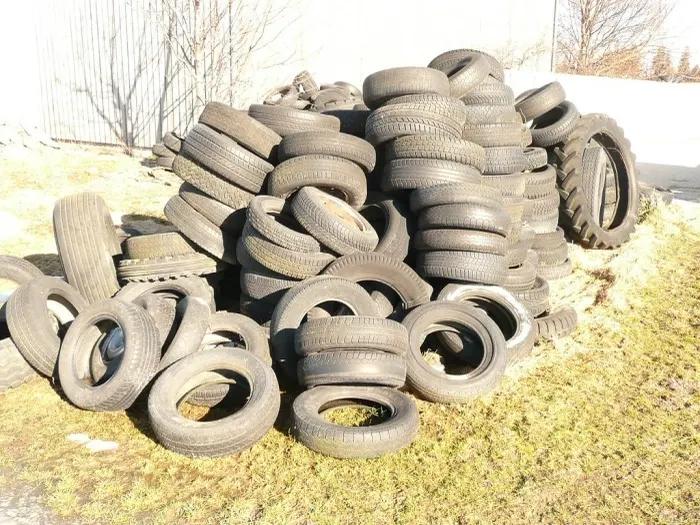
Hero image: “Stack / pile / batch of old used car and tractor tires / tyres / tire” by photosteve101 (source), licensed under CC BY.