
What Engine Oil Does My Car Need?
To find the right engine oil for your car, check your handbook for the specified viscosity grade, such as 5W-30, and the manufacturer specification it must meet. Both matter: the grade describes how the oil flows in cold and hot conditions, while the specification ensures it meets your engine's requirements. Using the wrong oil can reduce protection.
Understanding viscosity grades
Oil grades like 5W-30 describe viscosity, or how the oil flows. The number before the W is its flow when cold, and the number after is its flow at operating temperature.
A lower cold number means the oil flows better on cold starts, which protects the engine in winter. Your car maker chooses the grade to suit your engine, so it is important to match it rather than guessing or buying whatever is on offer.
Manufacturer specifications
The grade is only half the story. Car makers also set approval specifications that the oil must meet, covering things like additives and compatibility with emissions equipment.
These are often listed as codes in the handbook. Modern engines, especially diesels with particulate filters, can be sensitive to using an oil that does not meet the correct specification, so the right spec matters as much as the right grade.
Where to find the right oil
The most reliable source is your owner's handbook, which lists both the grade and the specification. Some cars also display oil information under the bonnet.
- Check the handbook for the grade, such as 5W-30, and the spec codes.
- If you have lost the handbook, we can look up the correct oil for your car.
- Do not simply buy the cheapest oil of roughly the right grade.
Fully synthetic, semi-synthetic and mineral
Oils also come in different types. Fully synthetic oils flow better when cold, resist breakdown at high temperatures and suit most modern engines, which is why many cars now specify them. Semi-synthetic is a middle ground, and mineral oil is found mainly in older or simpler engines.
The type that is right for your car is determined by the grade and specification in your handbook, not by price alone. Using a cheaper, lower-spec oil than your engine needs is a false economy that can shorten its life, so match what the maker requires.
Why you should not just top up with any oil
In an emergency, topping up with a slightly different oil of a similar grade to reach a garage is better than running low. But routinely mixing oils, or topping up with the wrong grade, is not ideal, as it dilutes the carefully chosen properties your engine relies on.
Keep a small amount of the correct oil in the boot for top-ups, and have the full oil and filter changed with the right product at service time. If you are ever unsure what to buy, ask us and we will tell you exactly what your car takes.
Why the right oil matters
Using oil of the wrong grade or specification can reduce engine protection, affect fuel economy and emissions, and in some cases cause damage over time, particularly to modern engines and their filters.
The simplest way to be sure is to let a garage handle it. When we carry out an oil change, we use oil that meets your car maker's exact grade and specification, so you never have to second-guess it.
Frequently Asked Questions
How do I know what oil my car needs?
Check your owner's handbook, which lists both the viscosity grade, such as 5W-30, and the manufacturer specification the oil must meet. If you have lost the handbook, a garage can look up the correct oil for your car. Both the grade and the specification matter.
What does 5W-30 mean?
It describes the oil's viscosity. The 5W is how the oil flows when cold, with a lower number meaning better cold-start flow, and the 30 is its flow at operating temperature. Your car maker chooses the grade to suit your engine, so it is important to use the specified one.
Can the wrong oil damage my engine?
It can. Using oil of the wrong grade or that does not meet your car's specification can reduce protection, harm fuel economy and emissions, and over time damage the engine or its filters, especially on modern cars. Always use oil matching your handbook's grade and specification.
What is the difference between synthetic and mineral oil?
Fully synthetic oil flows better when cold and resists breakdown at high temperatures, suiting most modern engines, while mineral oil is found in older, simpler engines and semi-synthetic sits in between. The right type for your car is set by the grade and specification in your handbook.
Can I top up with a different oil in an emergency?
To reach a garage without running low, topping up with a similar-grade oil is better than driving on too little. But avoid routinely mixing oils or using the wrong grade. Keep some of the correct oil in the boot for top-ups, and have the full change done with the right product.
Book With Norwich Tyres & Auto Service
Need a hand from a real, independent Norwich garage? Call 07933 900901 or pop into Ber Street, NR1 3ES. Same-day tyre fitting is available on most common sizes, with free parking on site.
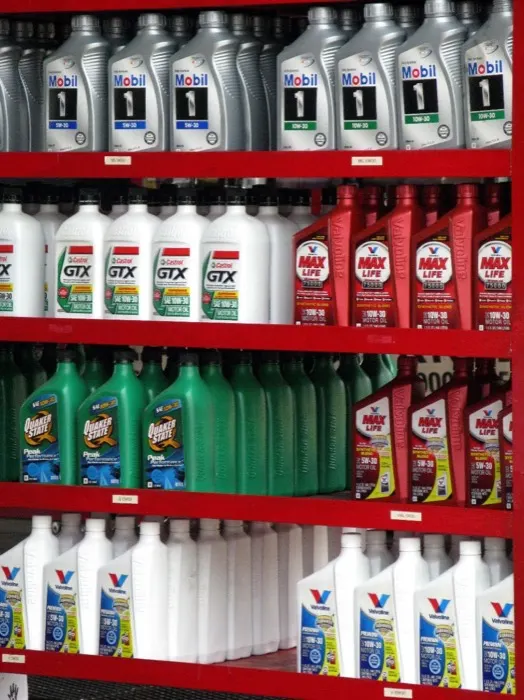
Hero image: “Motor oil bottles variousbrands” by Frankieleon (source), licensed under CC BY.