
Nail in Your Tyre: Can It Be Repaired or Do You Need a New One?
A nail in your tyre can often be safely repaired if it is in the central three-quarters of the tread and the tyre is otherwise sound. Punctures in the sidewall or shoulder, or on a tyre that has been driven on flat, cannot be repaired and need replacing. Do not pull the nail out, as it may be the only thing sealing the hole.
When a puncture can be repaired
A puncture can usually be repaired when the object has gone into the central three-quarters of the tread (the main grip area), the hole is small, and the tyre is otherwise in good condition with legal tread.
A proper repair removes the tyre from the rim, inspects it inside for hidden damage, and fits a combined plug-and-patch from the inside to the British Standard. This is a safe, permanent repair, not a quick external plug, and it costs a fraction of a new tyre.
When you need a new tyre
Some damage cannot be safely repaired, and fitting a new tyre is the only option.
- Punctures in the sidewall or the shoulder (the edge of the tread).
- A tyre that has been driven on while flat, which damages the structure.
- Large holes, splits or multiple punctures close together.
- A tyre already at or near the legal tread limit.
Trying to repair these would be unsafe and is not permitted.
Why you should not pull the nail out
It is tempting to pull a nail straight out, but resist it. While the nail is in place it often partly seals the hole, so a slow leak stays slow; pull it out and you can turn it into a fast deflation.
Instead, leave the nail where it is, keep the tyre inflated if you can, and drive gently and slowly to a garage, or call for help if the tyre is going down fast. We can then inspect it properly and tell you whether it is repairable.
Repair standards and safety
A safe puncture repair follows the British Standard (BS AU 159). That means removing the tyre, inspecting the inside for damage the outside does not show, and fitting a combined plug and patch from within, not just an external string plug.
External-only plugs and tyre sealants are temporary, get-you-home fixes, not permanent repairs. A tyre that has had a poor repair, or has been run flat, may have hidden internal damage, which is why a professional inspection matters before trusting a repaired tyre at speed.
What about run-flats and sealant kits?
Run-flat tyres are a special case. Once driven on with low or no pressure, their structure may be compromised, so most makers advise replacement rather than repair even for a simple nail.
If your car has a sealant repair kit instead of a spare, it can get you to a garage but is a temporary measure: the sealant coats the inside and a proper inspection is still needed afterwards. Bring the tyre in and we will assess honestly whether it can be repaired to standard or needs replacing.
Get it checked promptly
Whether it is a slow leak or a sudden flat, do not keep driving on a punctured tyre any longer than you must, as running it flat can turn a cheap repair into a new tyre.
Bring the wheel to us and we will inspect it, carry out a British Standard repair where it is safe, or fit a new tyre if it is not, often the same day. We will always tell you honestly which it is.
Frequently Asked Questions
Can a nail in my tyre always be repaired?
No. A nail in the central three-quarters of the tread can usually be repaired if the tyre is otherwise sound, but punctures in the sidewall or shoulder, large holes, or a tyre driven on while flat cannot be safely repaired and need replacing. We inspect each one to confirm.
Should I pull the nail out of my tyre?
No. The nail may be partly sealing the hole, so pulling it out can turn a slow leak into a fast deflation. Leave it in place, keep the tyre inflated if you can, and drive gently to a garage, or call for help if it is going down quickly.
Is a tyre repair safe?
Yes, when done to the British Standard: the tyre is removed, inspected inside for hidden damage, and a combined plug-and-patch fitted from within. This is a safe, permanent repair. External-only plugs and sealants are temporary get-you-home fixes, not proper repairs.
How much cheaper is a repair than a new tyre?
A puncture repair costs only a fraction of a new tyre, which is why it is well worth checking whether the damage qualifies before replacing. The saving is significant, so do not assume a nail automatically means buying a new tyre until it has been inspected.
Can run-flat tyres be repaired after a puncture?
Usually not. Once a run-flat has been driven on with low or no pressure, its structure may be compromised even if it looks fine, so most manufacturers advise replacement rather than repair. We will inspect it and advise honestly whether replacement is genuinely needed.
Book With Norwich Tyres & Auto Service
Need a hand from a real, independent Norwich garage? Call 07933 900901 or pop into Ber Street, NR1 3ES. Same-day tyre fitting is available on most common sizes, with free parking on site.
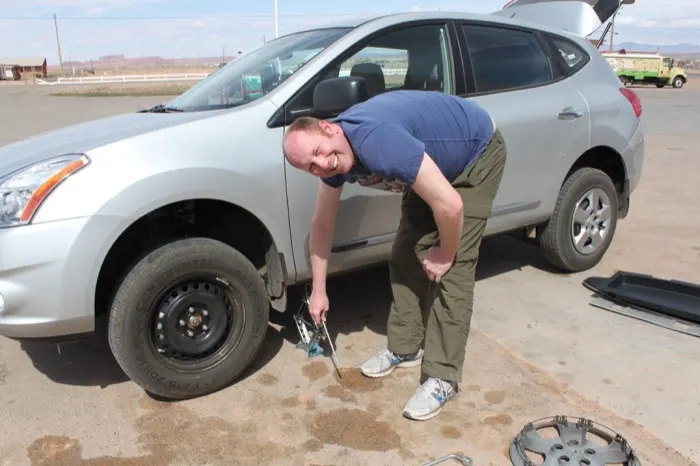
Hero image: “Well it wouldn't be a road trip if we didn't get a puncture!” by Disgwylfa (source), licensed under CC BY.