
Tyre Rotation: Is It Worth It and How Often?
Tyre rotation means swapping your tyres around the car to even out wear, since front and rear tyres wear at different rates. It can be worth it on many cars, helping all four wear out closer together and last longer overall. But it is not suitable for every car, and it does not fix underlying problems like misalignment.
What tyre rotation is
Tyres rarely wear evenly across a car. On most vehicles the front tyres wear faster because they handle steering and much of the braking, and on front-wheel-drive cars the engine's power too.
Rotation moves the less-worn tyres to the busier positions and vice versa, so over time all four wear down at a more similar rate. The pattern used depends on whether the tyres are directional and on the type of car.
Why it can be worth doing
The main benefit is value. By evening out the wear, rotation helps you get the full life out of all four tyres and replace them as a set, rather than buying new fronts long before the rears are worn.
- More even wear across all four tyres.
- Often longer overall tyre life.
- More balanced grip and handling as tyres wear.
It also gives a regular chance to inspect each tyre closely.
When rotation is not suitable
Rotation is not right for every car. Directional tyres (with an arrow showing the direction of travel) can only move front-to-back on the same side, and asymmetric or staggered setups, where front and rear tyres are different sizes (common on performance cars), cannot be rotated at all.
Some cars also specify against it. We will check your tyres and car before rotating, and if it is not suitable we will tell you, rather than doing something that could compromise handling or wear the tyres incorrectly.
How often to rotate
A common guideline is to rotate every 6,000 to 8,000 miles, or at each service, but check your handbook as some makers give their own advice. There is no need to be rigid about it; roughly that interval keeps wear reasonably even.
A practical approach is to have it considered whenever the car is in for a service or other tyre work, so it fits naturally into the car's routine without a special trip.
Rotation is not a cure for bad wear
It is important to understand what rotation does not do. If your tyres are wearing unevenly because the alignment is out, a tyre is under-inflated, or a suspension part is worn, rotation only spreads that uneven wear around the car; it does not fix the cause.
So if you see one-sided or feathered wear, the priority is to find and fix the underlying problem, with an alignment check and a look at pressures and suspension, before worrying about rotation.
Should you bother?
For many everyday cars on regular tyres, rotation is a sensible, low-cost way to get a little more life from a set. For cars with directional, asymmetric or staggered tyres, it may not be possible, and that is fine.
The bigger wins for tyre life are still correct pressures, sound alignment and smooth driving. If you would like us to check whether rotation suits your car and do it at your next visit, just ask when you book your tyre work or service.
Frequently Asked Questions
What is tyre rotation?
Tyre rotation means swapping your tyres around the car to even out wear, since front and rear tyres wear at different rates, with fronts usually wearing faster. Moving them periodically helps all four wear down at a similar rate so they last longer and can be replaced as a set.
Is tyre rotation worth it?
On many everyday cars with regular tyres, yes, as it evens out wear and helps you get the full life from all four. But it is not suitable for directional, asymmetric or staggered setups, and it does not fix underlying causes of uneven wear like misalignment.
How often should I rotate my tyres?
A common guideline is every 6,000 to 8,000 miles or at each service, though you should check your handbook for any specific advice. A practical approach is to have it considered whenever the car is in for a service or tyre work, so it fits into the normal routine.
Which cars should not have tyres rotated?
Cars with directional tyres can only move them front-to-back on the same side, and those with asymmetric or staggered setups (different front and rear sizes, common on performance cars) cannot be rotated at all. We check your tyres and car first and advise if rotation is unsuitable.
Will rotation fix uneven tyre wear?
No. Rotation only spreads existing uneven wear around the car; it does not fix the cause. If tyres are wearing one-sided or feathered, the priority is to fix the underlying issue, such as misalignment, incorrect pressures or worn suspension, before considering rotation.
Book With Norwich Tyres & Auto Service
Need a hand from a real, independent Norwich garage? Call 07933 900901 or pop into Ber Street, NR1 3ES. Same-day tyre fitting is available on most common sizes, with free parking on site.
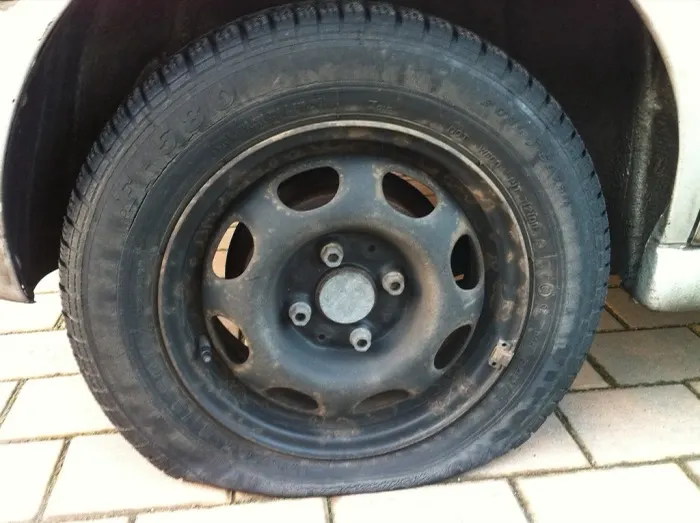
Hero image: “Flat Tyre” by Sean MacEntee (source), licensed under CC BY.