Brake Fluid Change Norwich
The service item most drivers skip and most manufacturers want every two years. We test the fluid, then replace it properly through all four corners.
Brake fluid is hygroscopic: it absorbs water from the air through the hoses and seals, a little every month, and water lowers its boiling point. New fluid boils at well over 200°C; fluid that is three years old can boil at half that, and when it boils under hard braking, coming down the hill into Norwich with a loaded car, the pedal goes long and soft and the brakes fade. That is why most manufacturers call for a change every two years regardless of mileage, and why it is the service item most often skipped. At Ber Street we test the fluid's moisture content first and replace it properly when it needs it.



How We Know It Needs Changing
A moisture tester in the reservoir gives a percentage in seconds; above about three percent the fluid has lost enough boiling point to matter. We also look at the colour and check the service history. A spongy or long pedal is the driver's clue, though that can also be air in the system or a leak, so we test rather than assume. If the fluid is fine we tell you and leave it alone.
What a Proper Change Involves
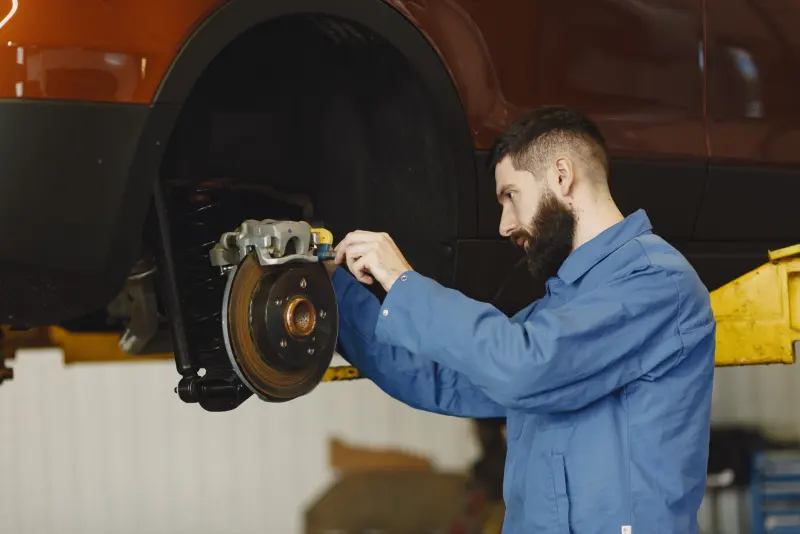
Topping up the reservoir does nothing: the old fluid is in the callipers, the furthest point from the reservoir, and that is where it boils. A proper change pressure bleeds fresh fluid through the system from the reservoir to each calliper in the correct sequence until clean fluid comes out at all four corners, with the ABS unit cycled where the car requires it. The fluid is the specification the manufacturer states, DOT 4, DOT 5.1 or a low-viscosity DOT 4 for many modern ABS systems, because using the wrong one affects how the ABS and stability control behave. The pedal is checked afterwards and the reservoir set to the correct level.
When to Do It
- Every two years on most cars, whatever the mileage, as part of the major service.
- Whenever the pedal feels spongy, long or inconsistent and there is no leak.
- With any brake repair where the system is opened, such as a calliper or hose.
- Before towing a caravan on the A47 or a trip abroad through mountains, where sustained braking heats the fluid most.

How often should brake fluid be changed? Most manufacturers specify every two years regardless of mileage, because the fluid absorbs water from the air and loses its boiling point over time. We test the moisture content and change it when it needs it.
Brakes as a Whole
A fluid change is the time to check the rest: pad thickness, disc condition, callipers sliding freely and flexible hoses for perishing, all part of our free brake check. If pads are due, our brake repair page and the brake pads cost guide explain what is involved. Call 07933 900901; open seven days with free parking at 100-106 Ber Street, 3-month / 3,000-mile workmanship guarantee.
How a Repair Works Here
Describe the symptom
Call or bring the car in. Diagnostic checks are priced before we plug in.
Diagnosed and quoted
We find the actual fault and quote the repair, itemised, before any work.
Repaired and guaranteed
OEM-quality parts, road tested, 3-month / 3,000-mile workmanship guarantee.
Book a Brake Fluid Change
Give us the registration. We test the fluid first, and if it is fine we say so rather than change it for the sake of it.
📞 07933 900901 Send an Enquiry ►Opening Hours:
Mon-Sat: 8:00am - 6:00pm
Sun: 10:00am - 4:00pm
Address:
100-106 Ber Street
Norwich NR1 3ES
Free parking on site
Get directions ›
Frequently Asked Questions
How often should brake fluid be changed?
Most manufacturers specify every two years regardless of mileage, because the fluid absorbs water from the air and loses its boiling point over time. We test the moisture content and change it when it needs it.
What happens if you never change brake fluid?
The water it absorbs lowers the boiling point until, under hard or sustained braking, the fluid boils, the pedal goes long and the brakes fade. It also corrodes callipers, cylinders and ABS units from the inside.
Can I just top up the brake fluid?
Topping up replaces none of the old fluid in the callipers where the heat is. A proper change bleeds fresh fluid through the whole system. A falling reservoir level also usually means worn pads or a leak, which needs checking.
Which brake fluid does my car need?
The specification in the handbook, usually DOT 4, DOT 5.1 or a low-viscosity DOT 4 for modern ABS systems. We fit the correct one because it affects how the ABS and stability control work.
How long does a brake fluid change take?
Under an hour on most cars, and you can wait. It is often done with a service or with brake pads.
Brake Work Across Norwich and Norfolk
Your nearest brake repair page:
Spongy Pedal, or Over Two Years Since the Last Change?
Call 07933 900901 or visit us at 100-106 Ber Street, Norwich NR1 3ES. Open seven days a week with free parking on site.
Get a Free Quote